Czech, Please!
| Extended Program Notes & Bios
-
Josef Suk (1874-1935) was a Czech composer and violinist. He became a student of Atonin Dvorak during his schooling. He was quite personally close with Dvorak, spending holidays with the composer's family, and taking lessons with Dvorak even after his schooling. Eventually, Suk would fall in love with and marry Dvorak's daughter Otilie. Suk is also one of the only classical composers to win a silver medal in the Olympic Games. In 1932, the Los Angeles Olympic Games included an art competition with medals for architecture, literature, music, painting and sculpture. Josef Suk won the silver medal with his composition Towards a New Life which is an uplifting fanfare and march which perfectly melds the triumphant sound of the olympics that we know today with his own Czech twist. Scherzo fantastique Op. 25 was composed in 1903 and lives up to its name. The word "scherzo" means joke, and often scherzos have a humorous edge to them. In this piece, Suk cleverly uses the tri-tone to shift tonalities as well as recapping sections at a half-step higher than they were originally. It's full of short outbursts and rhythmic hemiolas that are very cleverly arranged. In the middle of the piece, Suk takes the bar of 3/4 (counted in one) and turns that into the new quarter note of the new section, a very clever way to slow down a piece of music that seems to keep tumbling over itself!
Notes by Samuel Ivory
-
The Lachian Dances, (in Czech: Lašské tance), a set of six dances, was the first mature work by Leoš Janáček. Written in 1888 to explore folk dances of his homeland, Moravia, they were originally called the Wallachian Dances until the Moravian Wallachia region's name changed.
The first movement, Starodávný, or "The Ancient One" was based on tunes collected by Janáček and František Bartoš in their important research into Moravian folk music. There are actually two dances in this movement: the "real dance" in 3/4 and the "ribbon dance" in 2/4. Janáček was greatly inspired by Dvořák's Slavonic Dances, although he is already starting to forge his own inimitable style that later produced works like the 1926 Sinfonietta.
Notes by Cameron Engel
-
A complement to the six Lachian Dances is the set of six Symphonic poems by Bedřich Smetana. The collection of poems, called Má vlast, or "My Fatherland" are sometimes performed all together in a single concert, and each depicts an aspect of Bohemia, Smetana's homeland. The second work in the cycle, completed in 1874, is called Vltava, or, The Moldau, honouring the longest river in the Czech Republic.
The music follows the winding river from its two small springs in the Bohemian Forest, one hot and one cold, and depicts various scenes in passing. These include a forest hunt, peasant wedding, water nymphs dancing in the moonlight, the St. John Rapids, the ancient Vyšehrad Castle seen nearby, and the eventual emptying into the majestic Elbe River.
One of the important themes is the Renaissance folk song "La Mantovana", also known as the Czech "Kočka leze dírou" ("The Cat Crawls Through the Hole"), which Samuel Cohen later adapted from a Romanian version of the song, for "Hatikvah", the national anthem of the State of Israel.
The piece has often been used as a symbol of cultural resistance at various times, notably during the Nazi occupation of Czechoslovakia, where performances of the work were prohibited. Similarly to Beethoven, Smetana composed this after he became completely deaf.
Notes by Cameron Engel
-
1. Allegro
2. Adagio ma non troppo
3. Finale: Allegro moderato
This concerto has variously been called the "supreme", "greatest" and the "king" of cello concerti.
Composed between 1894 and 1895, during what has been called Antonin Dvořák's "American period," it is full of emotion, lyricism and extremely rich orchestration, where every instrument plays a part. He was long reluctant to write a cello concerto, questioning its suitability as a solo instrument. He complained that the upper register was “too nasal”, and that the lower register was “growling” or “mumbling”. He did admire its “fine” and rich middle register. He admitted in a letter that he himself was probably the most surprised of all people that he had written a cello concerto.
The second movement has a special story. When he was young, Dvořák was desperately in love with Josefina Čermáková, an actress who happened to be his piano student. While the love was unrequited, he still referred to the love as having "not come to nothing". He actually married her younger sister, Anna, and was, therefore, able to remain close. While composing his concerto, he learned Josefina was gravely ill. So, he incorporated her favourite song of his, "Kéž duch můj sám" ("Lasst mich allein", or “Leave Me Alone") into the second movement.
When he learned of her death, he wrote a coda at the end of the concerto, in abject grief at her passing. He was so determined this should be the lasting message of the concerto that he insisted there be no cadenzas in the concerto. The Czech cellist Hanuš Wihan saw the score and suggested two cadenzas, along with other changes, to which Dvořák responded in a letter to his publishers:
"I give you my work only if you will promise me that no one – not even my friend Wihan – shall make any alteration in it without my knowledge and permission, also that there be no cadenza such as Wihan has made in the last movement; and that its form shall be as I have felt it and thought it out. The finale should close gradually with a diminuendo like a breath… then there is a crescendo, and the last measures are taken up by the orchestra, ending stormily. That was my idea, and from it I cannot recede."
Johannes Brahms, when he heard the concerto, said, "If I had known that it was possible to compose such a concerto for the cello, I would have tried it myself!"
Notes by Cameron Engel
President & CEO of the Vancouver Academy of Music
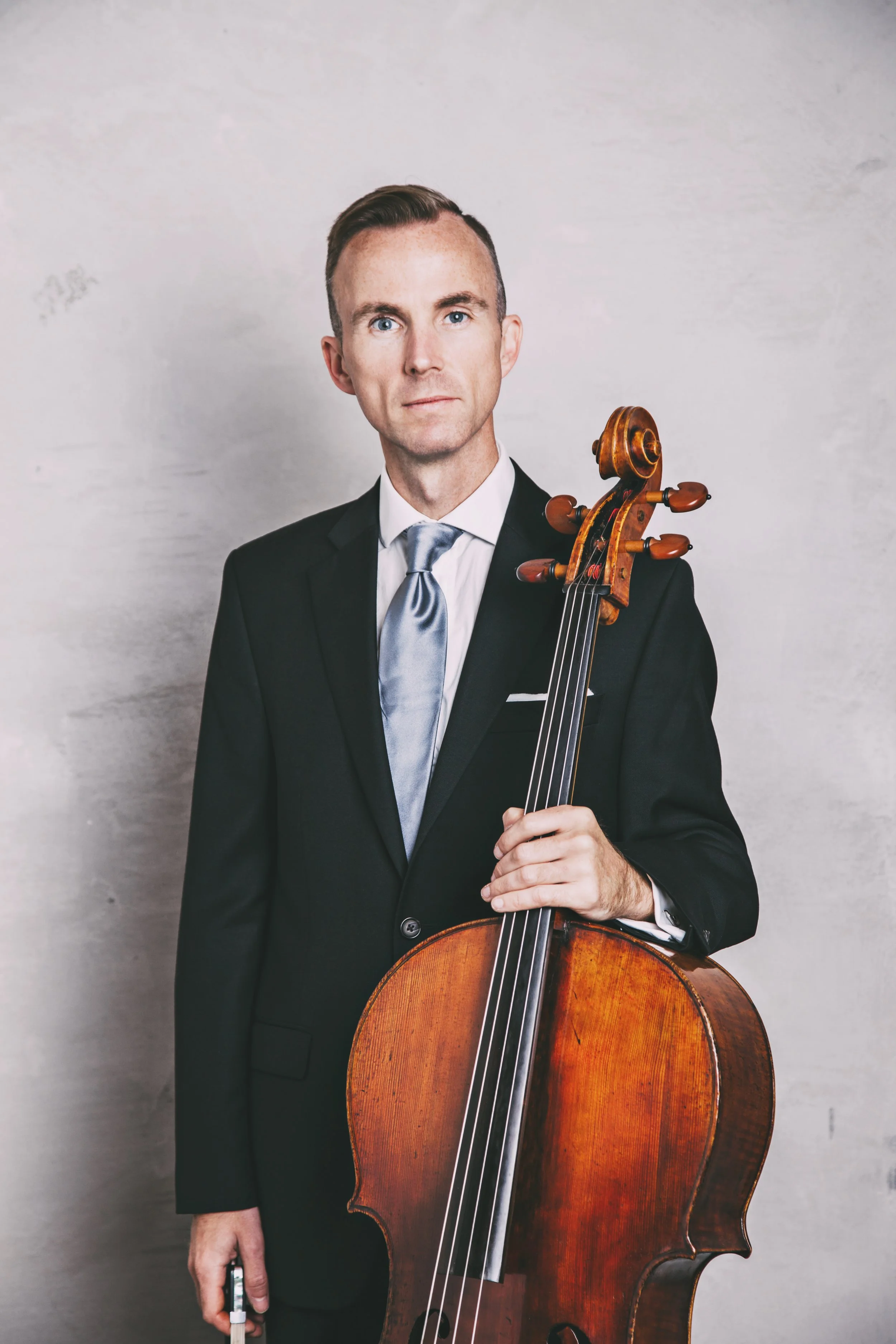
Joseph Elworthy, driven by his passion for music education and performance, has graced the stages of Alice Tully Hall, Suntory Hall, Carnegie Hall, the Library of Congress, and Sejong Hall as a featured soloist, recitalist, and chamber music performer. His exceptional contribution to Canadian Arts and Culture has earned him the prestigious title of Fellow of The Royal Conservatory of Music. His music, a testament to his dedication, can be enjoyed on EMI, Sony, Archetype, Naxos and Bose record labels.
In addition to receiving the Sylva Gelber Award, Joseph has received multiple Canada Council career grants. Mr. Elworthy is a graduate of the Juilliard School and Yale University, where he received the Aldo Parisot/Yo–Yo Ma Prize, the highest honour issued by Yale University to a graduating cellist. Mr. Elworthy has been a visiting artist at the Beijing Conservatory, Harvard University, the Royal Northern College of Music, the Glenn Gould School, and the Royal Conservatory of Music.
Joseph Elworthy is co-artistic director of the Sea to Sky Summer Chamberfest and the Academy Chamber Players. Mr. Elworthy served as Western Music Advisor for the Haw Par Music Foundation – a collaborative educational initiative linking Vancouver and Hong Kong from 2012 to 2023. Prior to his appointment as VAM’s President & CEO in 2011, Mr. Elworthy was a member of the Vancouver Symphony Orchestra for twelve years. Joseph plays on a cello made by Ian Crawford McWilliams that is modelled on the legendary ‘Sleeping Beauty’ cello of 1739 by Domenico Montagnana.